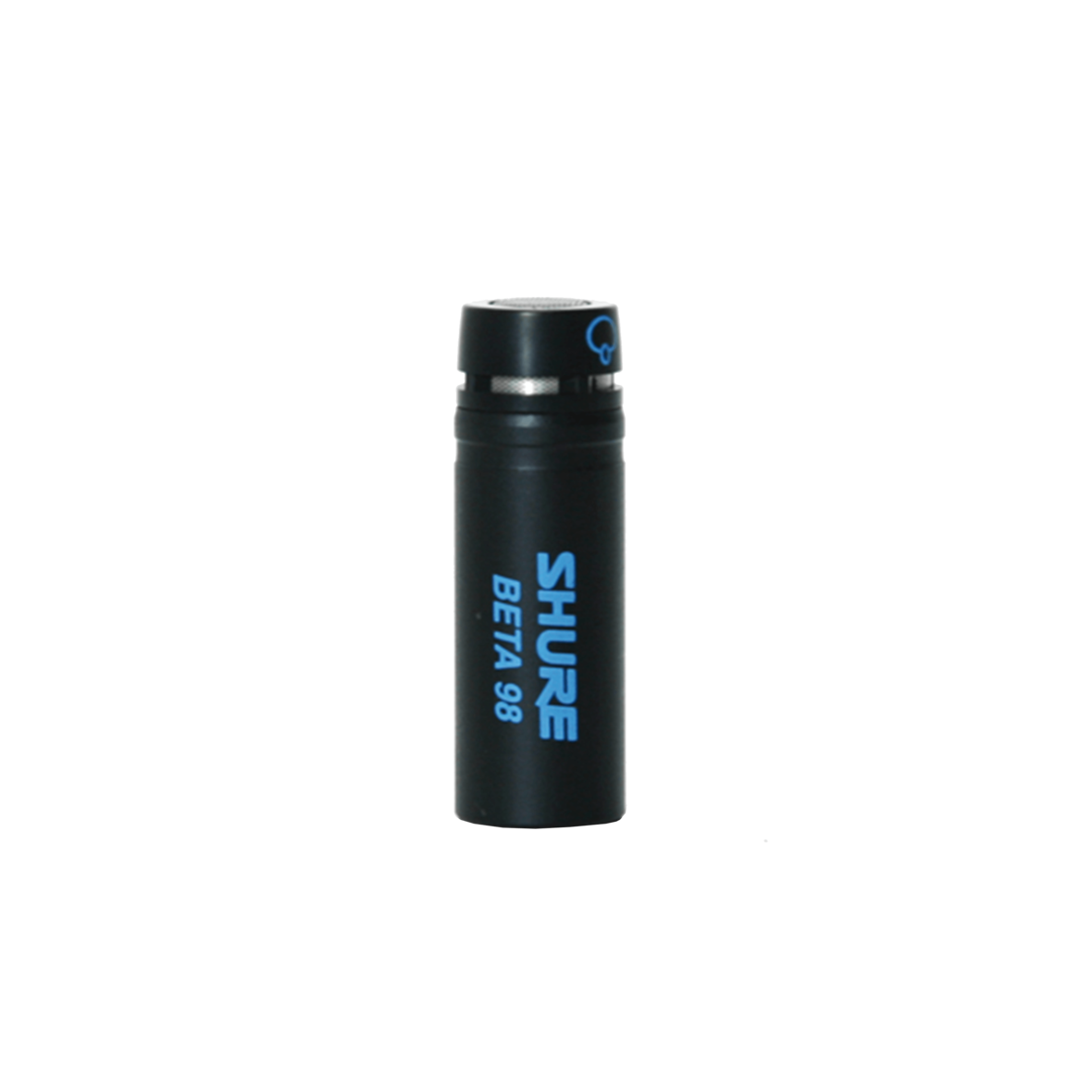
Beta 98S Intrument Microphone
Where to buy
Best suited to:
Brass,
Snare, Toms,
Percussion
Also great for:
Further acoust. instr.
- Description
- Features
- Specs
- Downloads
- In the box
What is the Beta 98S best suited to?
It’s a premium instrument microphone which is ideal for use with a variety of instruments such as drums, conga, piano, reed, wind and string in both stage and studio applications.
What are the Charactaristics of the Beta 98S?
It has a tailored frequency responseThis is the range of frequencies, from the lowest to the highest, that a mic can pick up.
Read moreGo to the glossary of 20Hz – 20KHz and a high maximum sound pressure level (SPL) of 125dB. It has a supercardioidPicks up most sound in front of the microphone and very little from the sides, making it more directional than a cardioid mic.
Read moreGo to the glossary pickup pattern providing high gain before feedbackSustained “howl” when a mic 'hears' a loudspeaker already reproducing that mic's sound.
Read moreGo to the glossary. A seperate in-line preamplifier is included as well as a 25ft detatchable cable to go between the pre-amp and the mic. The pre-amp output is through a male XLR socket, and requires phantom powerThis must be provided to all condenser microphones in order for them to operate.
Read moreGo to the glossary.
This mic is also available with a drum mount. See Beta 98D/S
- Tailored frequency responseThis is the range of frequencies, from the lowest to the highest, that a mic can pick up.
Read moreGo to the glossary for studio quality performance - Wide dynamic rangeThis is the difference between the queitest and loudest sound that a mic can pick up.
Read moreGo to the glossary for use in high SPL environments - Uniform supercardioidPicks up most sound in front of the microphone and very little from the sides, making it more directional than a cardioid mic.
Read moreGo to the glossary pattern for high gain before feedbackSustained “howl” when a mic 'hears' a loudspeaker already reproducing that mic's sound.
Read moreGo to the glossary and superior rejection of off-axis sound - Optional A98D drum mount is unobtrusive and versatile, allowing precise positioning of the microphone while holding it firmly in place
- Compact design reduces stage clutter
- Detachable cable for easy storage
- Interchangeable microphone cartridges with different polar patterns"Polar pattern" describes how well the microphone “hears“ sound from different directions.
Read moreGo to the glossary are available - Legendary Shure quality, ruggedness, and reliability
- Transducer TypeA transducer converts sound into an electrical signal. The two most common types are dynamic and condenser.
Read moreGo to the glossary : CondenserCondenser microphones are more sensitive, give a smooth, natural sound and need to be powered.
Read moreGo to the glossary - Polar Pattern"Polar pattern" describes how well the microphone “hears“ sound from different directions.
Read moreGo to the glossary: SupercardioidPicks up most sound in front of the microphone and very little from the sides, making it more directional than a cardioid mic.
Read moreGo to the glossary -
Frequency ResponseThis is the range of frequencies, from the lowest to the highest, that a mic can pick up.
Read moreGo to the glossary:
20 Hz
- 20 kHz
-
SensitivityThis is how mich signal a microphone produces for a given amount of sound.
Read moreGo to the glossary (1 kHz):
-59 dBV/Pa / 1 mV/Pa
- Equivalent Selfnoise:
35 dB(A)
- Sound Pressure:
160 dB
- Weight: 12 g
- FrequencyThis is how many times a sound or radio wave oscillates in one second.
Read moreGo to the glossary Repsonse Curve:
User Guides
- Storage Bag (Part No: 26B21)
- Preamplifier (Part No: RPM626)
- Shock Mount Swivel Adapter (Part No: RK282)
- 7.6m lightweight cable (Part No: 90A4697)